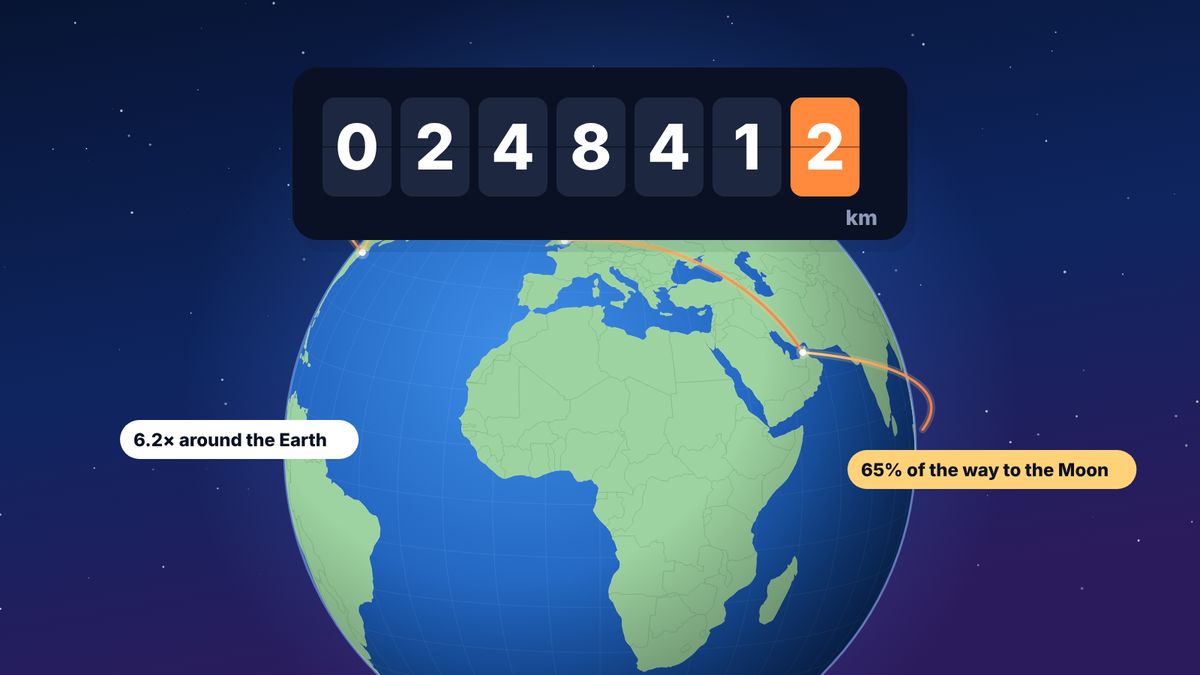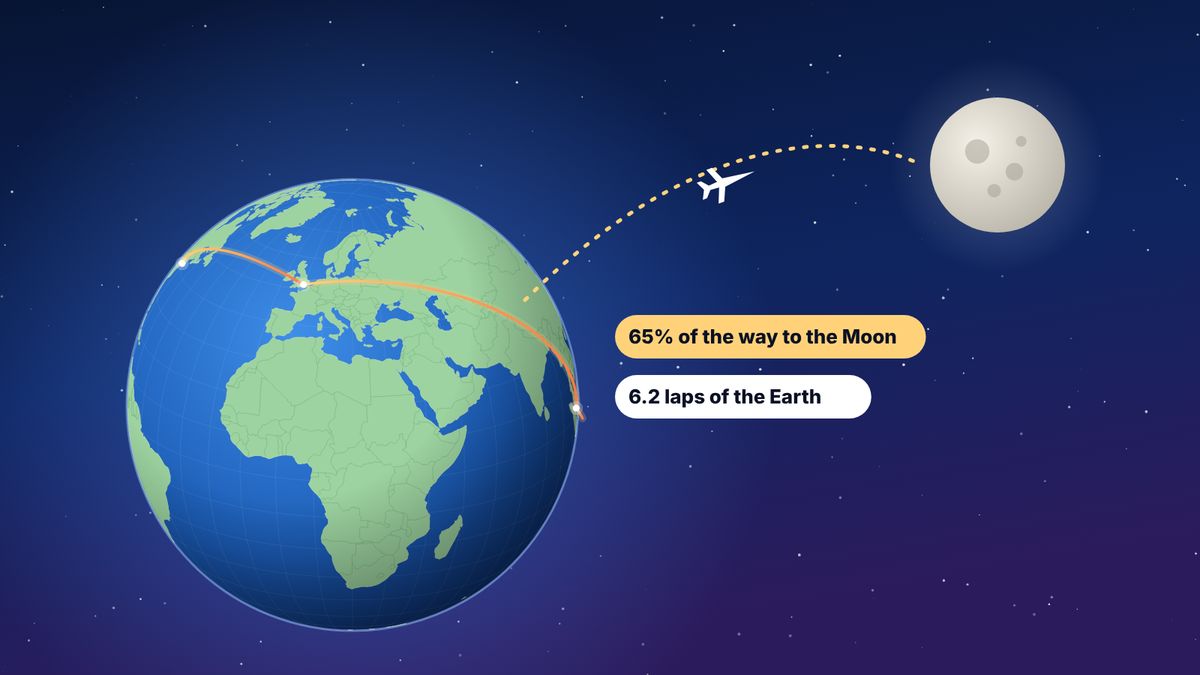
Once around the Earth at the equator is 40,075 km (24,901 miles), about seven flights between London and New York. The Moon is on average 384,400 km (238,855 miles) away, about 70 London–New York flights, and there and back is 768,800 km. A million miles is 1,609,344 km, about 40 laps of the Earth. Log your flights and a flight log such as flew.world shows how far along you are, with badges for going around the world and reaching the Moon.
A flight log turns hundreds of separate journeys into one number: the distance you have flown. On its own, “212,000 km” is hard to picture. Milestones make it real. You haven’t just flown a lot; you have been around the world five times and are more than half way to the Moon.
The milestones
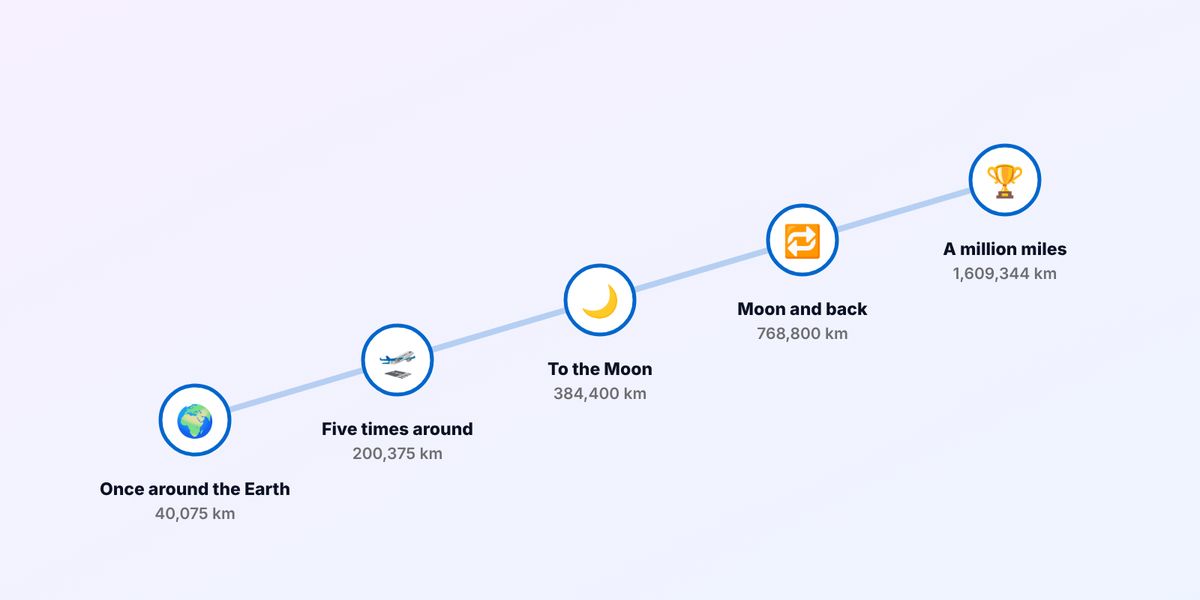
| Milestone | Distance | London–New York flights to get there |
|---|---|---|
| Across Europe | 4,000 km | under 1 |
| Once around the Earth | 40,075 km (24,901 mi) | about 7 |
| Five times around the Earth | 200,375 km | about 36 |
| To the Moon | 384,400 km (238,855 mi) | about 69 |
| To the Moon and back | 768,800 km | about 139 |
| A million miles | 1,609,344 km | about 290 |
| To the Sun | about 149.6 million km | about 27,000 |
London to New York (Heathrow to JFK) is 5,540 km as a great-circle distance. Your own flights will be a mix of short and long, so the number of flights varies a lot.
Once around the Earth: 40,075 km
The Earth’s circumference at the equator is 40,075 km. Measured around the poles it is a little less, about 40,008 km, because the Earth is slightly flattened; the equator is the usual benchmark.
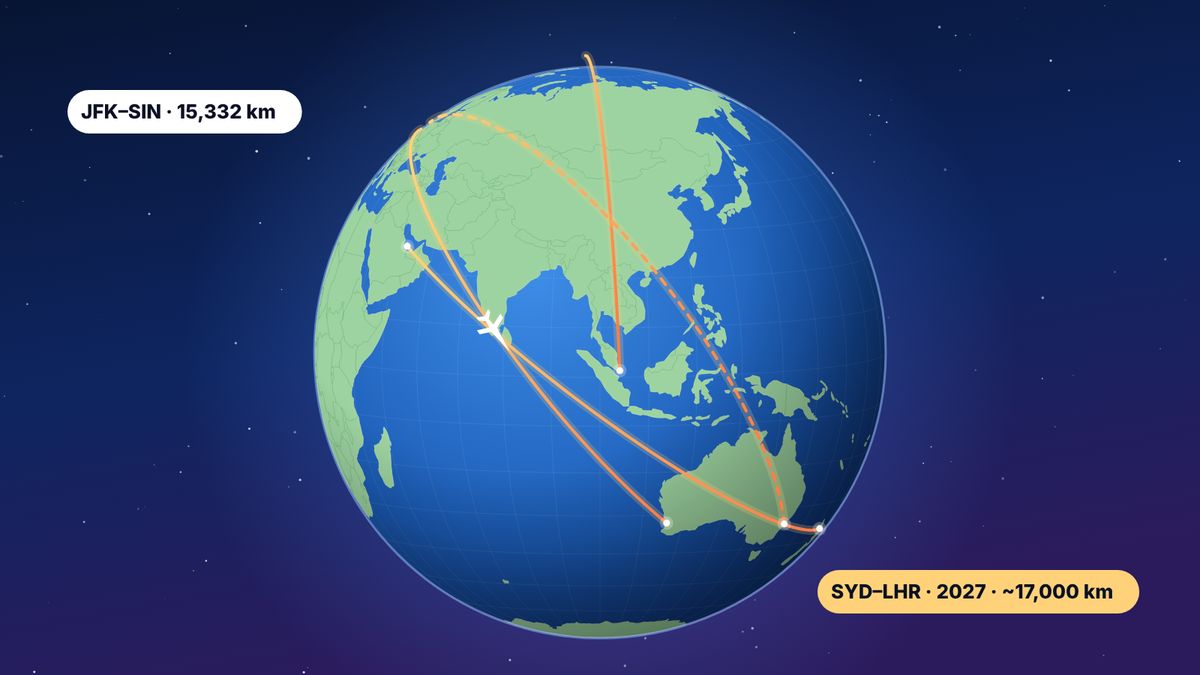
Who gets there? Almost anyone who flies long-haul. One return trip from Europe to Southeast Asia or Australia covers half of it or more: London to Sydney and back is about 34,000 km. Someone who takes three or four short holidays a year in Europe might reach it in five years or so.
Could you do it in one trip? Round-the-world tickets let you circle the globe with several stops. The distance flown is usually well over 40,075 km, because routes go via hubs rather than along the equator.
To the Moon: 384,400 km
The average distance from the Earth to the Moon is 384,400 km. It varies by about 50,000 km over the Moon’s orbit, so 384,400 km is the standard figure.
Who gets there? Regular business travellers often do within a decade or two. Commuting by air once a week on a 1,000 km route adds about 100,000 km a year, counting the return flights. Many long-serving airline crew pass it many times over.
A million miles: 1,609,344 km
“Million miler” is a status some airlines award to their most loyal passengers. Airline programmes usually count miles flown with that airline or its partners, and sometimes miles earned rather than flown, so their million may not match your logbook’s.
In great-circle terms, a million miles is about 40 times around the Earth, or a little more than to the Moon and back twice.
How long it takes different travellers
Rough figures, to show how much the way you fly matters:
| Traveller | Typical year | Once around the Earth | To the Moon |
|---|---|---|---|
| Two European holidays a year | 4 flights of about 1,500 km: 6,000 km | about 7 years | about 64 years |
| One long-haul holiday a year | 2 flights of about 9,000 km: 18,000 km | about 2 years 3 months | about 21 years |
| Monthly short business trips | 24 flights of about 1,000 km: 24,000 km | about 1 year 8 months | about 16 years |
| Weekly commuter by air | 104 flights of about 1,000 km: 104,000 km | about 5 months | about 3 years 8 months |
Add your history and you’ll know exactly where you are, rather than guessing.
Other milestones worth tracking
Distance isn’t the only measure. Flight logs often celebrate:
- Flights: 10, 25, 50, 100, 250, 500.
- Countries: 5, 10, 25, 50, and every continent.
- Airports: 25 different airports is a good mark for a regular traveller.
- Airlines: 10 different airlines.
- Firsts: your first long-haul flight (7,000 km or more), first ultra-long-haul (12,000 km or more), first crossing of the equator or the date line, first airport above the Arctic Circle.
- A busy year: 20 or more flights in one calendar year.
flew.world marks all of these as badges on your map as you reach them, including Around the world (more than 40,075 km in total) and To the Moon (more than 384,400 km).
Time in the air
Hours are another way to see it. A frequent flyer with 300 flights may have spent more than 25 days of their life in the air. Time in the air is your recorded flight times where you have them; otherwise a fair estimate is the distance at 800 km/h, plus 30 minutes per flight for taxi, take-off and landing.
How to see your own progress
- Log your flights on flew.world: flight number and date, a boarding pass, or an import from Flighty, myFlightradar24, OpenFlights or App in the Air.
- Fill in the past using your email and airline accounts; see how to find your old flights.
- Look at your map. Your total distance, laps of the Earth, progress to the Moon and time in the air are at the top, and each year gets its own page.
Your yearly totals compare with the year before, so you can also set a goal: once around the Earth in a single year is a satisfying one. See travel goals for 2027.
Questions
How many kilometres is it around the world?
About 40,075 km (24,901 miles) around the equator, or about 40,008 km around the poles.
How far is the Moon from Earth?
On average about 384,400 km (238,855 miles). It varies by about 50,000 km over its orbit.
How many flights does it take to fly around the world?
In distance, about seven London–New York flights, or one return trip to Australia from Europe, which covers most of it.
What is a million miler?
Someone who has flown a million miles, about 1.6 million km. Airlines award million-miler status based on their own programme rules, which may count only their flights.
How do I find out how far I have flown?
Log your flights in a flight log. flew.world adds up the great-circle distance of every flight and shows your laps of the Earth and progress to the Moon.
Updated 2 November 2026. Spotted something out of date? Tell us at hello@flew.world.